

The Cottage
A flash fiction inspired by Harald Sohlberg's painting 'Fisherman's Cottage'.

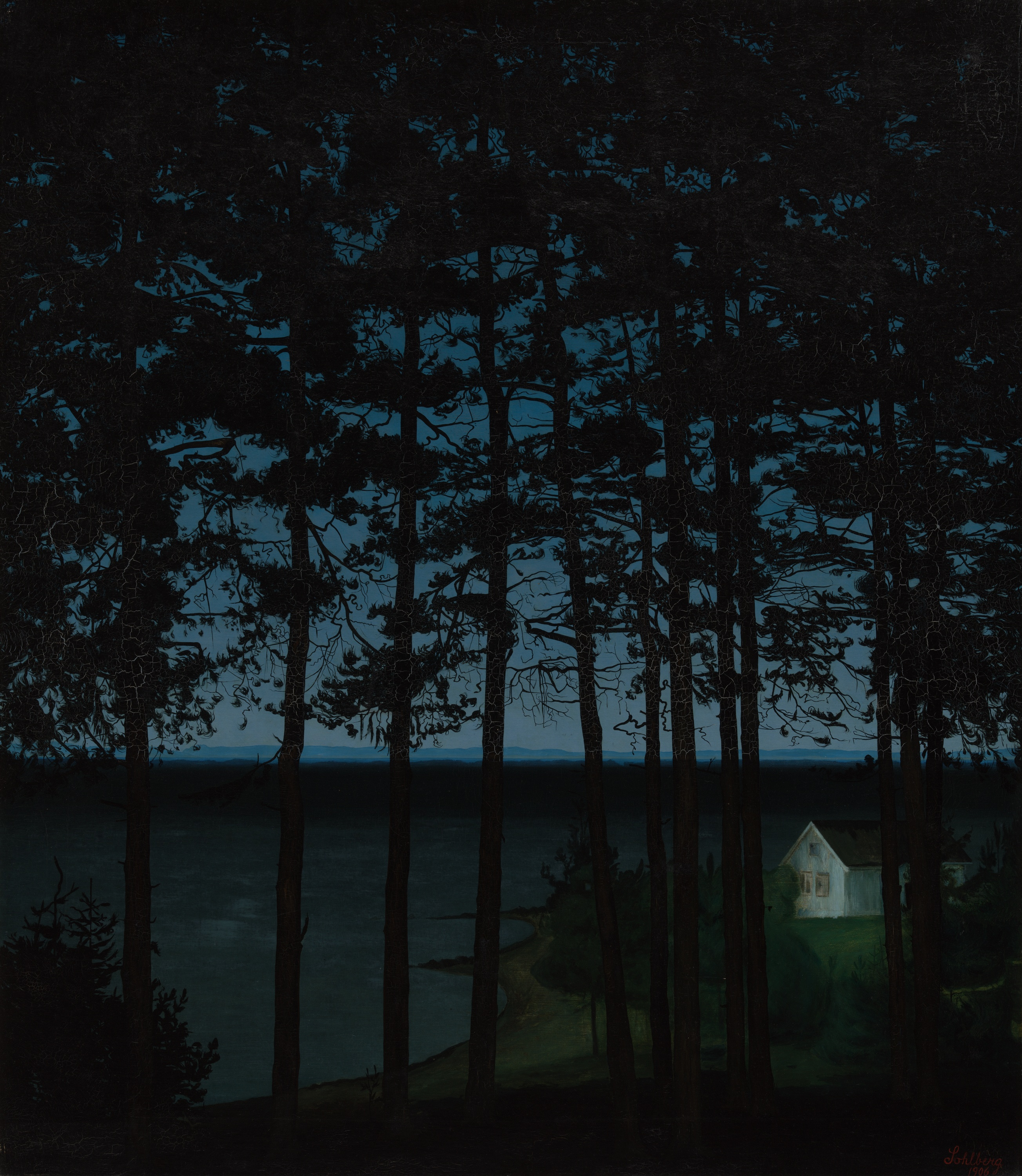
The Cottage
N. A. Strathdee
The children had visited the cottage many times. Squatting in the shadows of the pines, its white walls were made slightly green by the reflection of the lake beyond and the moss which grew in its cooler shadows. The roof, though, was solid, and the windows unbroken. The furniture inside was sparse, but not rotting in the way one would expect after years of abandonment.
For years, the cottage had been a type of refuge. When sudden summer thunder storms struck, low and heavy and drowning, the children would race there, throwing open the doors and collapsing onto the floor. Inevitably, a child would reach up to flick the light switch, and as it had for many years, the single hanging bulb there remained dark. After all, there wasn’t even power connecting the cottage to the grid, but it had bulbs and fuses and switches all the same.
There was also the matter of the door. The other room. They chose to leave it alone.
Over the years, despite the lack of obvious ownership, the cottage had been subjected to little more than rumour. On occasion, a particularly bold and bawdry teenager would make their way into the town, boasting of smashed windows and spraypainted walls. Yet, when the children returned, nothing in the little cottage had changed. The walls remained their slightly off-white colour, the windows their dusty yellow, unfractured.
Once, a villager claimed to have saw a tree fall right through the middle of the cottage - the result of a particularly violent and windy day. Yet, once again, when the children returned, the cottage remained unchanged. This bolstered the children. They came to believe the cottage was theirs and theirs alone, and that no one else knew its whereabouts and anyone claiming to have seen or done harm must have inflicted it upon some other poor fisherman’s home.
Despite this sense of ownership, the children maintained a tepid relationship with the cottage, only entering when necessary. When the odd child - usually new to the group, or the area - suggested camping overnight at the cottage, the others disagreed, though were never quite sure why. Sometimes, they would go weeks without wandering the banks by which the cottage rested - even though the fishing there was always good, some of the best around.
As the children got a little older, their fear began to taunt them, and they took to taunting each other. It was a tired, old cottage, they agreed. Nothing more. They nodded amongst themselves, laughing with a shallow tightness, for none could ignore that the cottage wasn’t really that tired after all, and they weren’t really sure just how old it was.
In truth, for all their self-imposed kingship over the cottage, they had never spent more than an hour there at a time. A small, gnawing feeling would often push them out, and they would forgo dry clothes for a chance to get home, to get away.
One day, however, on the verge of finishing their final years of schooling and separating off, into the real world, they made the pact to explore its walls once more. A goodbye, of sorts, they agreed amongst themselves.
The sun was high overhead that day and they marched with the solemnity of soldiers, a few fighting jokes failing to break the tension. They told themselves they were nervous about growing up, not about visiting some silly, old cottage they had visited heaps of times before. They walked inside. A hand flicked the light switch. The bulb remained dim. They sat down, at the table this time, not spread across the floor - which had been their habit for so many years. The silence echoed between them.
What were they trying to prove again?
One child rose, began opening empty cupboards. After assessing the investigation, the other children joined in. Soon, all the children were crawling about the cottage, opening windows, moving furniture, not quite sure what they were looking for, but knowing what they were avoiding.
The door.
The cottage had one other room beside the small kitchenette they stood in; none had ever entered. The odd brave boy had tried to peak through the windows outside, but the moss and grime had prevented any insight.
Standing together that afternoon, the children cajoled each other into opening the door. The jokes turned to jeers and soon the smallest of the group was being shoved forward. Relenting, and shivering just so, he placed his hand upon the doorknob, intending to turn the handle after he had mustered enough courage, but the pressure of his touch was enough to creak the door open all the same.
The door opened into a small bedroom, empty save for a small metal bedframe, its mattress folded in half. The children laughed. And laughed. And laughed. Soon they were on the floor, tears streaming down their jolly, red cheeks, rolling amongst the fine layer of dust which carpeted the floor.
The laughing stopped when the smallest spotted it. A handle. A latch. A trapdoor. Bolstered by the bravery which had brought him through the door, he reached for it. A shadow passed over the sun. The room darkened. Without shifting the bed, the boy found he could open the trapdoor wide enough to spot a shimmering of light. He crawled in. The others, equally transfixed, followed. The trapdoor fell closed with a muted slap. It would not reopen.
That evening, a local villager wandering the lake - enjoying the last of the summer skies - noticed the light was on in the little white cottage.
Passionfruit on the Vine is a free-to-read artistic endeavour, where I challenge myself as an author to write one short fiction piece a week. If you enjoyed this piece and want to support my journey you can buy me a coffee. Any and all support is welcome and appreciated!
A little about the artwork…
I was drawn to this painting by its slightly unsettling tone. The muted sunset, the soft glow of the cottage, all reminiscent of Scandinavian horror stories where even the simplest things are not quite what they appear. The painting itself is by Harald Sohlberg (1869-1935), who according to Emily Spicer of Studio International is one of Norway’s most treasured artists1. Taking inspiration from Paul Gauguin and a heated rivalry with Edvard Munch, Sohlberg would be defined by his evocative and slightly haunting artworks.

https://www.studiointernational.com/harald-sohlberg-painting-norway-review-dulwich-picture-gallery
I loved the tension and the atmosphere you built here!
Loved this one Nicole. Great tension and contrast between the innocence of the children and the (possibly) darker forces lurking just outside the story's frame.