

The Dancers
A flash-fiction inspired by Henri de Toulouse-Lautrec painting 'At the Moulin Rouge.'

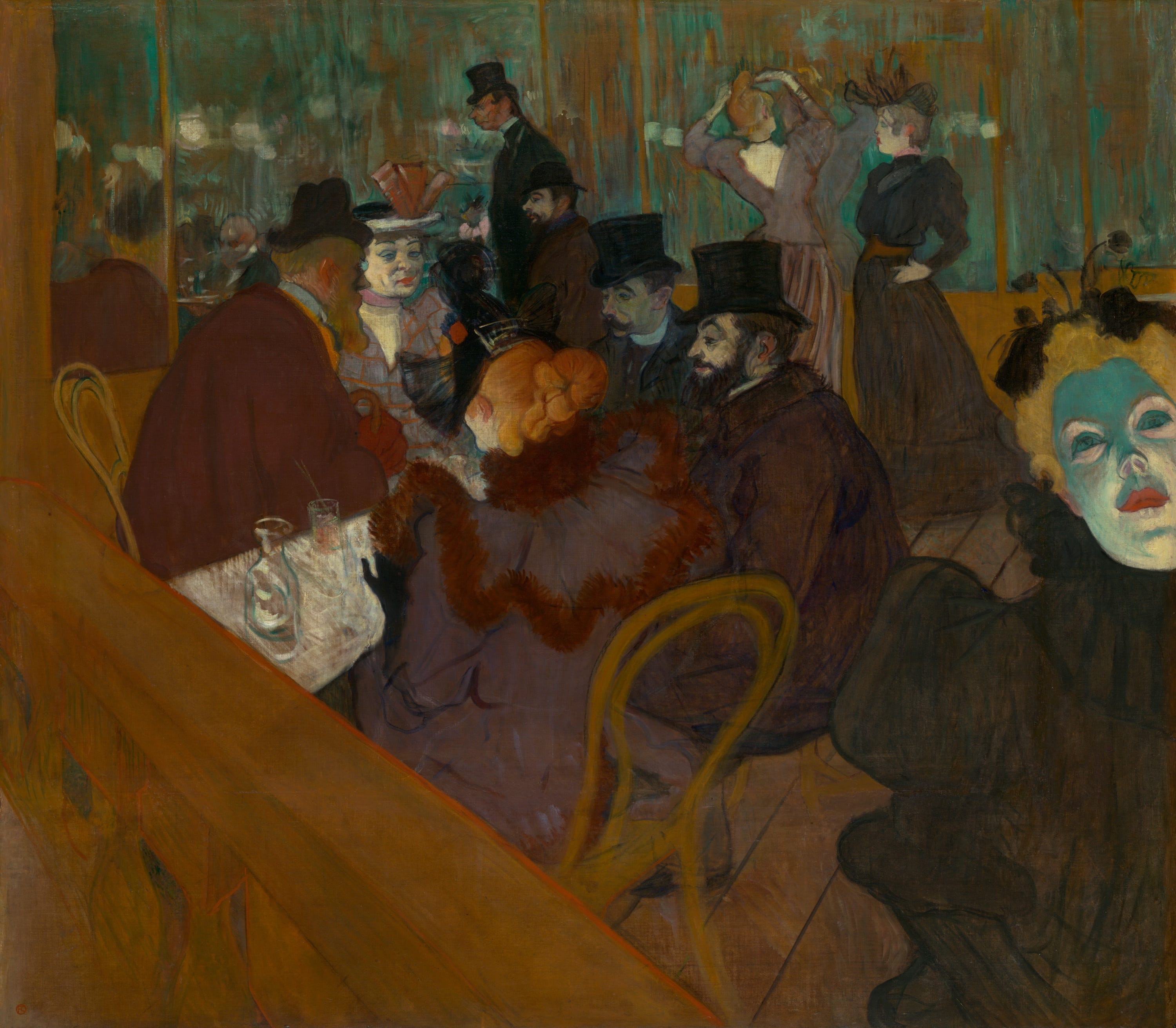
The Dancers
N.A. Strathdee
Despite the echoes of its popularity, it was in many ways a seedy place. Electric lights - a modern rarity of the time - hung too high in the rafters competed with those shuttering on low tables; all throwing calamitous shadows and giving an air of mischief. The brows of the customers always seemed drawn, all seemed to lean slightly forward in their chairs, secrets shared over glasses of that hallucinogenic green liquor which had become as much as a symbol of the place as the windmill outside.
Of course, this place was no secret. In many ways it had always seemed to be the slightly tarnished jewel in Paris’s wavering crown. It was a symbol of considerations past and aspirations forward. With a constant buzz in the air, it was a well-contained riot of flashing skin, spilled champagne and celebrity. All of which Edouard had come to know well. He, who had worked there almost since the beginning, wandered the backstage; lowering the curtain, sweeping the dressing rooms, repairing the wallpaper supplied by artists of the day, darning the dresses. Endless tasks flowed out of such a place, and he didn’t mind one bit.
So engrained was Edouard in the fabric of the place, few really noticed him, nor cared to notice. He didn’t mind. It allowed him the chance to spy on them all, up close. After all, it was a place for the legendary and notable, the notorious and the lauded. Artists, profiteers, musicians, dancers. Wealthy women fluttering jewelled fingers at up-and-coming writers (young enough to be their sons), those still desperate enough to welcome a matron.
It was a cavern of reckless abandon and he drank it all down as so many others had done before him. Over his years, he had collected dozens of secrets, enough to shatter friendships, marriages, political alliances, but in truth, he had no clue about what to do with the information which lingered in the recesses of his mind. It simply wasn’t his nature. In fact, more than once he had been forced to convince some young visitor that the affair or bribe he had witnessed in the darkened corners of the building were nothing more than hallucinations, nothing more than the green fairy whispering in his ear. Work which went often unnoticed.
Despite the calibre of men and women who surrounded him each night, Edouard had no grand aspirations for improvement and the change of status which came with his position. After all, he was simply too old for all of that. So, despite the uncertain attitudes of his patrons, and the overt disgust for his employers, Edouard continued his work from dusk to dawn. Paris wasn’t his city. The country was his home, and though he missed their rolling fields, he stayed. He had made a promise. A promise he was close to fulfilling.
Often he thought of going home, returning to those sundried fields and the work of his family. But, he stayed. He stayed for the dancers. The girls who saw his work, the girls who thanked him for clean dressing rooms and lowered eyes. The girls who brought him bread and wine for his evening meal, or ordered a steak from the kitchen just to have one bite and claim they simply couldn’t eat anymore, and would he like to finish it off?
He stayed for the girls who called him “papa” with an earnestness which made his heart quiver. There were so many girls over the years who honoured him with that title. Only one, in his long years of working at the infamous building hadn’t called him by that name. Only one girl never called him “papa.”
In truth, he stayed for her. Amalie. Amalie, who flirted with all of the patrons and had captured the eyes of the visiting artists. Her visage now painted the walls of this, his new home town. In many ways, Amalie had worked the hardest. She often arrived early - ahead of everyone except him - and spent more time learning the moves, the intricacies of them, than anyone else. She would throw him a casual nod on arrival, and though she spent much of time ignoring Edouard, her own dressing area was the cleanest and required the least work from him.
One would suspect, in all their years working so close together they would at least form something akin to friendship. After all, they were similar in so many ways, with the same dry sense of humour, the same crinkle at the edge of their bright blue eyes, the same tendencies to throw their head back and laugh with abandon. Mirrored eccentricities only one of them appreciated. In many ways though, they both held themselves aloft, distant. Her, for the sake of her bourgeoning fame. He, for the sake of the photograph pressed against his heart. It was a photograph of a child; small, pale blonde. She stood square in the centre of the frame, wheatfields disappearing behind her. Her school uniform was dirty, but her smile revealed the crinkles at the edges of her eyes.
Edouard hadn’t seen her in many years. His daughter had been lost to him the moment she turned fourteen, rebelling against a livelihood which had kept generations of his family fed, clothed and housed. Her abandonment had been sudden, but not unexpected, though his wife promised she would never forgive him if he did not set out to bring their little girl home.
For the better part of a decade, he had been trying. The dance parlour had offered many opportunities and many rumours about many girls arriving from the fields for new lives. He had seen hundreds, maybe thousands of young girls come through the place, auditioning, seeking work, on the arms of men, accompanying women. He had a letter written and ready to beseech his daughter to come home, if only he could track down her address. He had kept trying, even after he received a letter saying his wife had passed, taken heartbreakingly quick by fever. He kept looking for his daughter, even after the second letter came, informing him that the family farm had been sold, that he had nothing to return too, that a much wider envelope would be delivered to him soon, a small severance for generations of work gone.
In fact, Edouard had kept trying until the very morning Amalie walked into his dressing rooms, all blonde hair and selfless laughter, showing the very promise for dance which had earned her her fame and an income most working women could only dream of. Though, in the beginning - on the nights she struggled and joked with the other girls about sleeping under the stage - he siphoned a little of his own severance into her pocket. Tips, he lied, from a particularly shy fan. He would say anything, just to watch those crinkles appear at the edges of her eyes.
Several years had since passed. The letter he wrote remained folded in his pocket, aged worn and wearied. Instead of handing it to his daughter, he handed his boss his notice. He was leaving, to where he was not sure, but this place no longer had any need for him. She was okay. She did not need her father. He needed to let his daughter go.
His girls were heartbroken. On the day he was set to leave, he arrived to the studio to find dozens of bouquets perfuming his storeroom. He checked the cards on each bouquet. Tear stained goodbyes from the girls he had cared for and watched over - even from dancers long since retired from the stage, dancers he assumed had forgotten him. But nothing from Amalie.
He kept the cards and bid the waiter put a bouquet on every table. Collecting his final belongings, he made one last lap around the building, bidding goodbyes to its ostentatious wallpaper, its memories, its ghosts. He was sure the scent of absinthe would linger on his skin evermore, but in truth, he didn’t mind.
As he made his way to the backdoor, the lights dimmed - the dancers were on the stage and Amalie would be at the lead. He had contemplated staying, watching one more performance from the jewel of the Moulin Rouge, but had thought against it. The acts were not one a father could appreciate. So he walked towards the door, his mind picturing Amalie’s fans cheering her on at centre stage. Yet, as he turned the final corner in the twisted hallways of the under stage, there she stood, magic in her costume, waiting just for him.
She moved towards him and took his hands, the softness of her palms grating against his own calloused ones. She leant forward, placing a warm and timid kiss upon his whiskered cheek, before leaning back to regard him, piercing blue eyes looking into piercing blue.
“Merci, papa,” she said gently, before dropping his hands and flitting back to the stage once more.
Passionfruit on the Vine is a free-to-read artistic endeavour, where I challenge myself as an author to write one short fiction piece a month. If you enjoyed this piece and want to support my journey you can buy me a coffee. Any and all support is welcome and appreciated!
A little about the artwork…
I had known for a long time I wanted to write a story which honoured the subtle magic of Toulouse-Lautrec’s stunning painting, but struggled to find the words. While I had intended to write something a little more ethereal, a little more eerie to honour the colouring of this famous piece, I ended up writing something much softer.
In a way, I feel this might honour Toulouse-Lautrec’s own relationship with the Moulin Rouge. His artworks are tied with the fame of the place, but they undoubtedly applaud and revere the women who made the red windmill famous. Toulouse-Lautrec’s works always centered the women, without demeaning them, without reducing them to bare ankles and thighs.
If you would like to find out more about Toulouse-Lautrec and his own relationship with Paris and the Moulin Rouge, the Art Institute of Chicago have some lovely words here and here.

i loved this piece. i love how you portray the harshness behind the spectacle, and how these spaces of fun, sparkles, and dance often hide very intricate, bitter stories. well done 🖤
"He would say anything, just to watch those crinkles appear at the edges of her eyes."
what a wonderful piece Nicole, have a great day!